
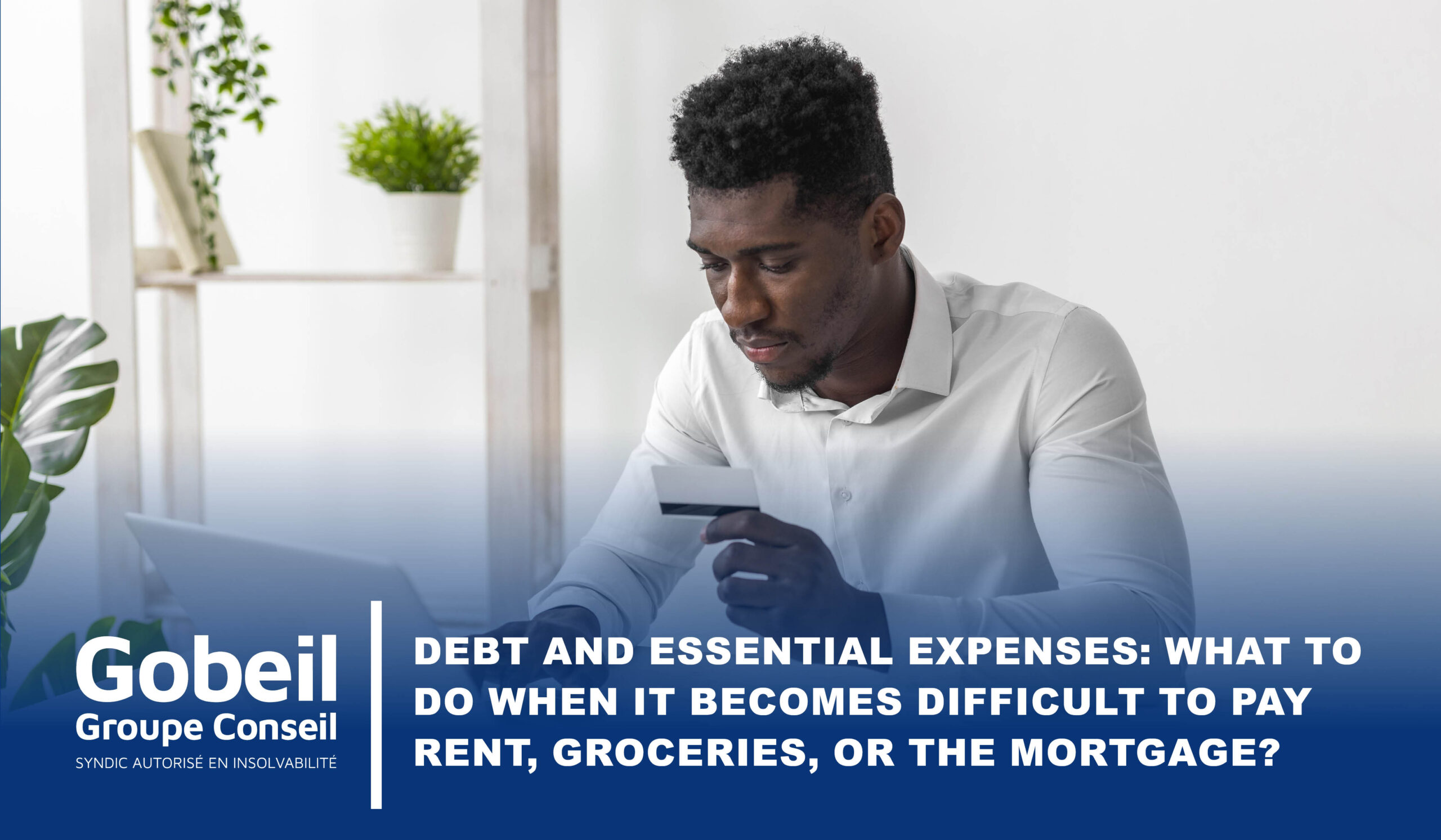
Debts and essential expenses: what to do when paying the rent, the groceries or the mortgage becomes difficult?
When debt starts taking up too much room in your budget, paying for your essential expenses can become difficult. You then have to choose between making the minimum payment on a credit card or buying groceries, paying the rent or settling an electricity bill.
This situation means that your budget no longer allows you to meet all of your financial obligations. It is time to look at the solutions that could help you before late payments and payment difficulties pile up.
Which essential expenses should be prioritized?
Essential expenses are the ones that allow you to meet your basic needs (for you and your family).
Depending on your situation, these expenses can include:
- rent or the mortgage;
- groceries;
- electricity and heating;
- transportation to get to work, to bring the children to daycare, etc.;
- medication and health care;
- insurance;
- the phone.
These essential expenses do not include debts such as credit cards, lines of credit or certain personal loans.
When your income does not allow you to pay for everything, your essential expenses come first and, after that, you need to determine how to handle your debts.

What should you do if your debts keep you from paying the rent or the groceries?
If your debts are keeping you from paying the rent, the groceries or your basic bills, review your financial situation quickly and avoid adding more debt (such as quick loans) to fill the gap.
Start by building your budget. Write down your monthly income as well as all of your current expenses. Then separate your essential expenses from the payments that are tied to your debts.
Make a list of your debts: credit cards, lines of credit, personal loans and other amounts owed. This will show you how much room the total of your monthly minimum payments takes up in your budget.
If you are already using a credit card to buy food, or if you have to borrow in order to pay another debt, the problem is likely to continue.
A free consultation (by phone) with a trustee will let you know which solutions could help you settle the situation. It is better to consult before your financial difficulties become more serious!
Should credit cards be paid before essential expenses?
Essential expenses should generally be prioritized over unsecured debts. Rent, groceries, electricity and certain other needs are necessary for daily life.
If you manage to make the minimum payment each month on a credit card, using that card to buy groceries will not solve your debt problem. The balance and the interest are more likely to keep growing.
You also have to consider the possible consequences of a late payment. If you constantly have to choose between your basic expenses and your debt payments, an overall review of your situation would be more useful than simply trying to make the next minimum payment.
To better understand the difficulties associated with credit cards, read our article on credit card debt.
What are the signs that your budget no longer works?
Your budget is no longer viable when your debts regularly force you to sacrifice your essential expenses or to use credit to cover them.
Some signs deserve your attention:
- you have to choose between paying the rent and paying a debt;
- you only make the minimum payments;
- you use your credit card to buy groceries because there is no longer enough money in your account;
- you delay paying certain bills in order to pay others;
- you borrow in order to repay another debt;
- your bank account is regularly overdrawn;
- you receive calls or letters from your creditors;
- you no longer have any financial room for unexpected expenses.
A single one of these signs does not necessarily mean that you are insolvent. But several of these situations together indicate that your debt load exceeds your ability to repay.
It is then better to have the situation assessed as a whole instead of continuing to go into debt.

Can debt consolidation help?
Debt consolidation can help some people simplify their payments and reduce the amount of interest to be paid. But it is not always possible when the ability to pay is not sufficient.
Consolidation consists of grouping several debts into a single financing (a personal loan granted by your bank or credit union). Instead of managing several payments, you then make a single payment with a lower interest rate.
Access to this solution depends on your income, your debt level and your credit file. Someone who already has a lot of debt or insufficient income could have difficulty obtaining the financing.
You should avoid seeing debt consolidation as a solution that automatically fixes everything. If you keep using your credit cards after grouping your debts, your budget could become difficult to manage again.
A review of your budget will determine whether this option is really suited to your situation.
When should you consider a consumer proposal?
A consumer proposal can be considered when certain debts become too heavy and you are no longer able to keep a balanced budget.
This procedure can include certain unsecured debts (such as credit cards), but the eligible debts must be determined by the trustee for each file.
Depending on the situation and on the creditors’ acceptance, a consumer proposal can allow you to offer a partial repayment of certain eligible debts. The payments are set according to the person’s financial capacity, over a maximum period of five years. Everything is done through a trustee, in accordance with the Bankruptcy and Insolvency Act.
The trustee reviews your situation and prepares the proposal when it is an appropriate solution. The creditors must then accept it or propose a higher amount to be repaid.
A consumer proposal therefore does not automatically mean that all of your debts will be reduced to the amount you offer. Acceptance depends in particular on the review of the file, your financial capacity, your assets, the amount offered and the creditors’ vote.
To learn more, see our page about the consumer proposal.
Is bankruptcy the only option if you can no longer pay your expenses?
No. Personal bankruptcy is not automatically the only solution when a person can no longer pay their expenses or their debts.
Depending on the situation, several other solutions may be possible before choosing bankruptcy, such as debt consolidation or a consumer proposal.
The choice depends on several factors: your income, debts, assets, expenses, ability to repay and personal situation.
So you should not make a decision simply because the payments have become difficult to make. A professional review by a trustee will let you know which solutions are available and what their consequences are.
Why consult quickly when essential expenses are affected?
When debt starts to interfere with paying for housing, groceries and other basic needs, consulting quickly can help keep the situation from deteriorating further.
Waiting until several payments are late is not necessarily to your advantage. The more the difficulties add up, the harder it can become to regain control of your budget.
A consultation will make it possible to examine the consequences of these elements:
- accumulated late payments;
- collection calls;
- interest that keeps adding up;
- deterioration of your credit file;
- constant use of credit;
- collection measures (such as wage garnishment).
If you already feel that you no longer have enough money to pay your current expenses, it is better to book a free call with our trustee before every month turns into a new financial emergency.

Frequently asked questions
Which expenses should be paid first when you have too much debt?
Essential expenses (housing, groceries, electricity, necessary transportation, medication, daycare, support payments, etc.) should be the priority. A review of your situation can help you establish them.
What should I do if I can no longer pay my rent because of my debts?
Quickly make a list of your income, your essential expenses and all of your debts. As much as possible, avoid adding a new debt (such as a quick loan) to pay another one. If the problem continues, consult our trustee to learn about the solutions within your reach.
Do I have to pay my credit cards before the groceries?
Essential needs such as food should be prioritized over unsecured debts. The consequences of a missed payment are real but vary from one situation to another. It is better to get advice quickly before making that decision.
Can consolidation help if my budget is too tight?
It can help some people, but it is not always available when debts are too large or when income does not allow you to support new financing. A review of your budget and your credit file is necessary.
Can a consumer proposal reduce my monthly payments?
A consumer proposal can make it possible to set payment terms that are adapted to your ability to pay. It does not guarantee a reduction of debts or payments: each file must be assessed individually.
When should you consult a licensed insolvency trustee?
You can consult as soon as your debts start keeping you from paying your essential expenses, or as soon as you regularly use credit to do so. There is no need to wait until you have many collection calls or late payments. The consultation is free, with no obligation, and can be done by phone.
When debt affects basic needs, it is time to act quickly
Running short of money to pay the rent, the groceries, the electricity or other essential expenses is an important signal that a solution has to be found.
The first step is to clearly understand your situation: how much you earn, how much you owe, what your essential expenses are and what your real ability to repay is.
If you have too much debt, it would be useful to review the different options before continuing to borrow in order to pay your current expenses.
A consultation with GOBEIL SYNDIC will let you take stock of your debts, your income and your ability to repay, and then learn about the solutions that could be available depending on your situation.
Book your free call with Gobeil Syndic.
We serve every city in Quebec, since many steps can be completed remotely.