
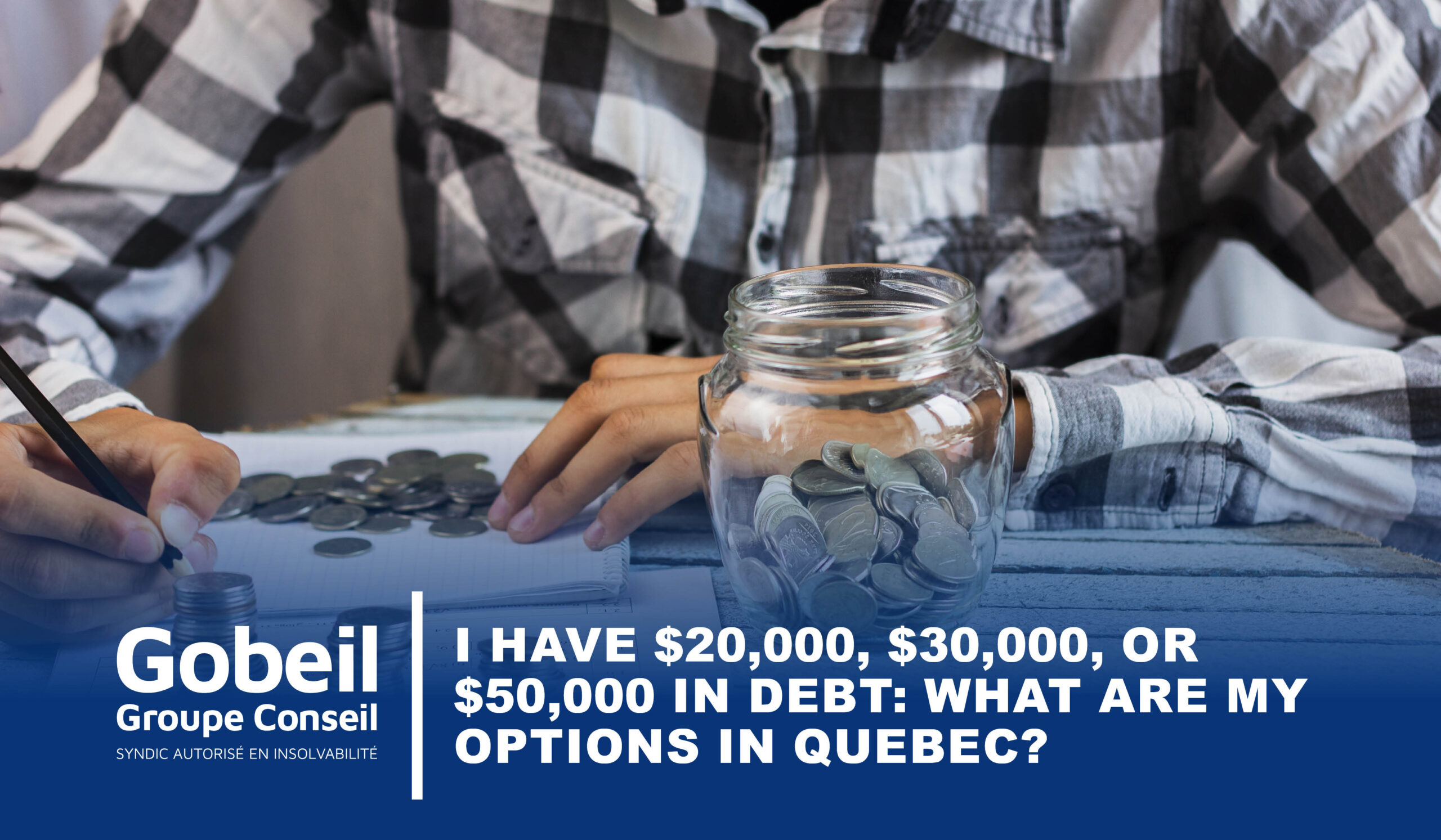
I Have $20,000, $30,000, or $50,000 in Debt: What Are My Options in Quebec?
Having $20,000 in debt, $30,000 in debt, or even $50,000 doesn’t automatically mean bankruptcy is inevitable.
Depending on your income, your repayment capacity, and the type of debts you have, several solutions can be considered (such as debt consolidation and a consumer proposal).
Discover the options available in Quebec and the signs that indicate it’s time to consult a Licensed Insolvency Trustee. The first step will be to draw a complete picture of your situation in order to determine which solution is best suited to you.
At what amount of debt does the situation become a problem?
It depends on the situation. A $20,000 debt can be a problem for someone without a high income, while a $50,000 debt can be well managed by someone with greater repayment capacity.
The main factors that make debt problematic are:
- the total amount of all your debts;
- the interest rates applied;
- the monthly payments required;
- the disposable income left after essential expenses;
- the type of debts;
- the ability to repay the principal and not just the interest.
Credit card debts, for example, can become difficult to control because of their high interest rates. Someone who makes only the minimum payments may see their balance go down very slowly, even after several years.
Lines of credit, tax debts, and personal loans can also increase financial pressure when they’re added to your other monthly payments.
Before making a decision, you therefore need to assess the situation as a whole rather than focusing only on the amount printed on your statements.

What to do with $20,000 in debt?
With $20,000 in debt, several solutions may be possible depending on your overall financial situation. The goal is to prevent interest and monthly payments from becoming unmanageable.
The first step is often to review your budget in order to determine how much you can realistically put toward repayment each month.
Some people can resolve their situation with:
- a reduction in expenses;
- a new budget structure;
- a payment arrangement with certain creditors;
- debt consolidation, when their credit record and income allow them to obtain favourable financing.
Debt consolidation is an option worth considering to reduce stress. Your financial institution grants you a single loan that combines several debts into one monthly payment. This can simplify managing your finances and let you obtain a better interest rate. But this solution isn’t available to everyone…
If the monthly payments become too high for your ability to pay, or if your debts keep growing despite your repayment efforts, a consumer proposal may be an option worth considering.
It’s better to act quickly rather than wait for late payments to pile up or for creditors to begin collection proceedings.
To better understand situations involving credit cards, you can also read our article on credit card debt and how to keep it from becoming a financial spiral.
What to do with $30,000 in debt?
With $30,000 in debt, the situation often becomes harder to manage, particularly when several creditors are involved.
The problem isn’t only the total amount, but the accumulation of monthly payments. A person may have:
- several credit cards;
- a line of credit used to its limit;
- a personal loan;
- minimum payments that take up a large part of the budget.
In many cases, people in debt feel like they’re making constant efforts without managing to reduce their balances.
For example, someone who owes $30,000 spread across several cards and loans may put several hundred dollars toward payments each month, without necessarily seeing a significant drop in the principal.
At this level of debt, it becomes important to compare the different options:
Debt consolidation
Consolidation can be attractive when the person has a stable income and a credit record that allows them to obtain a new loan with better terms.
However, it doesn’t always solve the problem when:
- income is insufficient;
- debts are already too high;
- the budget doesn’t allow for the new monthly payments;
- credit has already been affected.
The consumer proposal
A consumer proposal is a process governed by the Bankruptcy and Insolvency Act, which allows a person to offer an agreement to their creditors (through a trustee).
Depending on the situation, this solution can make it possible:
- to reduce the total amount to be repaid;
- to have a single monthly payment;
- to no longer pay interest;
- to avoid personal bankruptcy.
Every situation must nonetheless be assessed individually by a Licensed Insolvency Trustee.
What to do with $50,000 in debt or more?
With $50,000 in debt or more, an analysis by a trustee is essential to determine the best strategy.
At this level, many people still try to manage the situation on their own by cutting certain expenses or using additional credit. Unfortunately, this can sometimes shift the problem rather than solve it.
A complete analysis will make it possible to examine:
- your income;
- your essential expenses;
- your assets;
- your secured and unsecured debts;
- your real repayment capacity.
A consumer proposal is a possible solution for some people with significant debts. It allows you to negotiate an agreement with creditors through a licensed trustee.
In other situations, when repayment capacity is too low and no other solution is possible, personal bankruptcy can be considered. But it should be analyzed as one option among several, based on the complete financial picture.
Making a decision out of fear alone can lead to a choice that doesn’t necessarily match your needs.
Comparison table of solutions by level of debt
| Solution | In which situation? | Main advantages | Good to know |
|---|---|---|---|
| Budget reorganization | You still have good repayment capacity and your payments are manageable. | Lets you regain control of your finances without borrowing more. | May be insufficient if interest rates are high or if debts keep growing. |
| Agreement with creditors | You’re having temporary difficulty making your payments. | Some creditors may agree to change the repayment terms. | Each creditor decides whether or not to accept an agreement. |
| Debt consolidation | You have a stable income and a credit record that allows you to obtain a new loan. | Combines several debts into a single monthly payment and may offer a more advantageous interest rate. | Isn’t available to everyone and generally doesn’t reduce the total amount of the debt. |
| Consumer proposal | Your payments have become difficult to make, but you want to avoid bankruptcy. | Can reduce the amount to be repaid in some cases, groups eligible debts together, stops interest, and replaces several payments with one. | This process is administered by a Licensed Insolvency Trustee and each file is analyzed individually. |
| Personal bankruptcy | Your repayment capacity is very low and other solutions aren’t possible. | Provides a fresh financial start when the situation has become unsustainable. | It’s a last-resort solution that carries certain consequences, particularly for your credit record. |
In summary: what solutions exist to reduce or manage your debts?
Several options can be considered in Quebec. The best solution always depends on your personal situation.
Reorganizing your budget
Getting a clear picture of your finances is often the first step to take.
It lets you know:
- the real amount of your debts;
- your current monthly payments;
- your essential expenses;
- the amount available for repayment.
A realistic budget sometimes makes it possible to regain control before the situation gets worse.
Negotiating with creditors
In some cases, it’s possible to speak with creditors in order to obtain different payment terms.
However, this solution depends on their willingness to accept an agreement, and it doesn’t always solve the problem when several debts are involved.
Consolidating your debts
Debt consolidation means combining several debts into a single payment.
It can simplify financial management, but it must be used carefully. Someone who takes out a new loan without changing their financial habits could end up struggling to make the payments.
Filing a consumer proposal
A consumer proposal is a solution frequently considered by people with significant debts.
It allows you to present a repayment offer to your creditors with the help of a Licensed Insolvency Trustee.
For many people, this process is an excellent alternative to bankruptcy when monthly payments have become impossible to make in full.
Considering personal bankruptcy in certain cases
Personal bankruptcy can be a solution when debts are too large and the person has no realistic repayment capacity. It’s a procedure set out in a federal statute.
However, it carries consequences for your credit record that must be explained before making a decision.
A consultation with a trustee lets you compare the options and choose the right solution.

Is a consumer proposal suitable for large debts?
Yes, a consumer proposal can also be an option for some people with significant debts (for example $50,000 or more), but it isn’t automatic.
This solution can generally include several unsecured debts, such as:
- credit cards;
- personal loans;
- certain lines of credit;
- certain tax debts, depending on the situation.
A proposal can reduce the amount of your debts and let you replace several payments with a single, interest-free monthly payment that’s much easier to manage. It can also stop certain collection proceedings, such as a wage garnishment.
But every situation is different. A Licensed Insolvency Trustee must analyze your income, your debts, and your repayment capacity before determining whether this option is appropriate.
When should you consult a Licensed Insolvency Trustee?
It’s recommended to seek advice when the following signs appear:
- you only pay the minimum amounts;
- you use a credit card to pay off another debt;
- your creditors contact you regularly;
- your salary is no longer enough to cover all the payments you have to make;
- your debts are growing despite your efforts;
- you avoid opening your bills because they stress you out.
You don’t need to wait until you’re in default or have too much debt to seek help.
The earlier you seek advice, the more options you have to find a suitable solution.
A free phone consultation with our licensed trustee will let you take stock of your situation and understand the options available to you.
The sooner you act, the more options you’ll have
Having $20,000, $30,000, or $50,000 in debt can seem insurmountable, but it doesn’t mean there are no solutions.
The best approach is to analyze your situation as a whole: income, expenses, types of debts, and real repayment capacity.
Whether through a budget reorganization, debt consolidation, a consumer proposal, or another solution, the goal is to find a realistic approach to regaining control.
Don’t wait until the situation becomes urgent. Book a free phone consultation with our licensed trustee to assess your options and determine which solution best matches your reality.
FAQ
Is $20,000 in debt a lot?
It depends on your income, your expenses, and your ability to make the payments. For some people, $20,000 can be manageable, while for others that amount can become very difficult to repay.
What should I do if I have $30,000 in credit card debt?
It’s important to analyze your budget and your options before interest keeps accumulating. Debt consolidation or a consumer proposal may be considered depending on your situation.
Can you avoid bankruptcy with $50,000 in debt?
Yes, some people can avoid bankruptcy thanks to other solutions such as a consumer proposal. A professional analysis by a trustee is necessary.
Can a consumer proposal reduce my debts?
In some cases, yes. The amount repaid depends on several factors, including your income, your assets, and your ability to pay. And interest generally stops accumulating as of the date the proposal is filed.
When should you consult a licensed trustee?
As soon as your payments become difficult to keep up with or your debts grow despite your efforts, it can be very helpful to get professional advice.
Can all debts be included in a proposal?
No. Certain debts cannot be included. A trustee can explain which debts can be included based on your situation.
Book a call!
Book your free phone consultation with our licensed trustee at Gobeil Groupe Conseil to assess your options based on your level of debt, your income, and your repayment capacity.
We serve every city in Quebec, since all steps can be completed by phone and by video conference.
Let us help you regain control for good!