

Tax Debts in Quebec:Can the CRA and Revenu Québec be Included in a Consumer Proposal?
In the majority of situations, tax debts can be included in a consumer proposal, including those owed to the Canada Revenue Agency (CRA) and Revenu Québec.
This is often a surprise. Many people believe that tax debts are “untouchable.” However, the law provides clear solutions to settle them, even when they have grown significantly.
Why Tax Debts Become a Major Problem
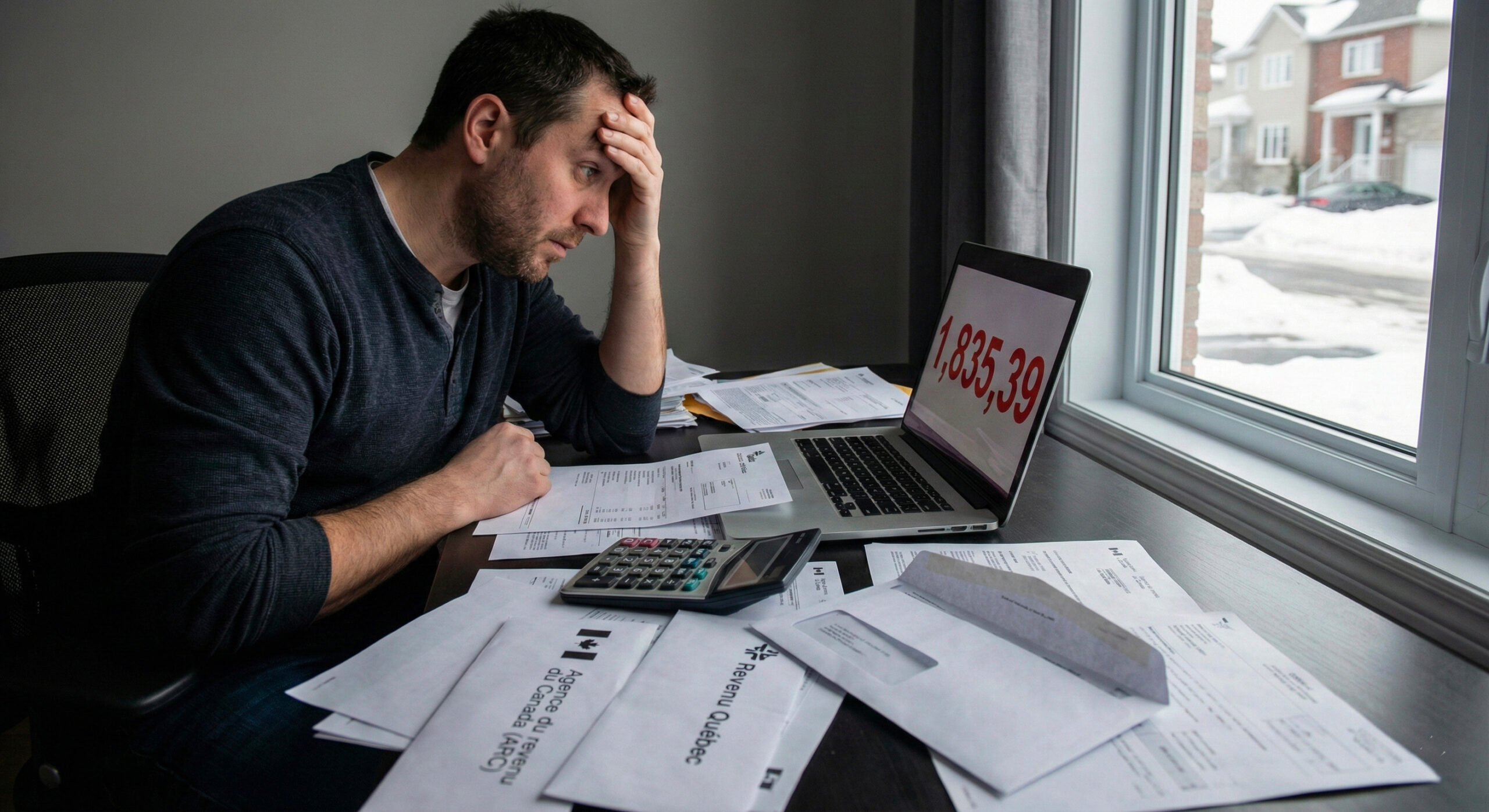
A tax debt never stays at the same level. As soon as a balance is unpaid, interest is added. Penalties can also accumulate. The amount quickly climbs, sometimes faster than a credit card balance.
Over time, the effect is cumulative. Unpaid years follow one another, and the amounts add up, creating a substantial debt. Added to this is the pressure from collection notices.
The CRA and Revenu Québec have extended powers to recover the money owed. They can proceed with a bank account seizure (after collection notices), intercept a tax refund to pay your debt, or impose a wage garnishment, sometimes without going through the courts.
The stress then becomes constant. Self-employed individuals are particularly at risk when they have not set aside money for taxes.
Are Tax Debts Different from Other Debts?
Partially, yes.
Debts to the CRA and Revenu Québec are government debts. These agencies have faster and more direct collection powers than traditional creditors.
That said, for an individual, a personal tax debt is generally considered an unsecured debt. It can therefore be treated within a legal framework like a credit card debt or a line of credit.
Some exceptions exist, notably for source deductions not remitted by a business.
But for most taxpayers, it is possible to legally manage personal tax debts through solutions like a consumer proposal or bankruptcy.
This allows for reducing payments, suspending interest, and regaining control of one’s financial situation without the debt continuing to grow uncontrollably.
Can Tax Debts be Included in a Consumer Proposal?
Yes. It is possible to include tax debts in a consumer proposal. This solution is provided for by the Bankruptcy and Insolvency Act.
Concretely, a debt to the CRA or a debt to Revenu Québec can be included in the offer filed by a Licensed Insolvency Trustee. This generally includes the tax owed, interest, and accumulated penalties.
To be eligible, you must be insolvent, meaning unable to pay your debts as they become due.
Your unsecured debts must not exceed $250,000 (excluding the mortgage on your principal residence), in accordance with the Bankruptcy and Insolvency Act. The proposal must be filed by a Licensed Insolvency Trustee.
Once the proposal is filed, interest ceases to accumulate. Collection measures are suspended. You then make a single monthly payment without interest, according to the accepted agreement.
Certain more complex situations (such as very high tax debts or several years of unfiled returns) require in-depth analysis.
Consumer Proposal or Bankruptcy for Tax Debts?
Both solutions can include tax debts.
The consumer proposal generally allows you to keep your assets and avoid bankruptcy. It often suits people who have a stable income and a partial repayment capacity. The impact on the credit file is real, but less severe than a bankruptcy.
For example, a self-employed individual who owes $15,000 to Revenu Québec for unpaid taxes can include this debt in their proposal and reduce their monthly payments, while avoiding seizures and suspending interest.
You can consult our article on the Consumer Proposal to understand its operation in detail.
As for bankruptcy, it can eliminate tax debts and prove more suitable when debts are very high or repayment capacity is insufficient. In certain urgent cases, such as an active seizure, it may represent the fastest solution.
The choice always depends on the person’s overall financial situation.
In certain particular situations, especially when personal tax debts exceed $200,000 and represent the majority of total debts, special rules may apply in case of bankruptcy.
A detailed analysis by a Licensed Insolvency Trustee is then essential to determine the best strategy.
The Role of the Licensed Insolvency Trustee in Tax Debts
The Licensed Insolvency Trustee is the only professional authorized to file a consumer proposal or bankruptcy.
Their role is not limited to filling out forms. They analyze your entire situation: tax debts, other debts, income, assets, and tax years filed or unfiled.
They verify the exact nature of your tax debts and evaluate the best legal strategy. They also act as the official intermediary with the tax authorities (CRA and Revenu Québec).
As soon as the file is submitted, legal protection comes into effect. Seizures and collection measures are suspended, and interest ceases.
Don’t Wait to Contact Us!
If you are indebted and preparing to file your taxes, contact our Licensed Insolvency Trustee now to book your free and confidential consultation.
You can obtain all the necessary information and then decide if you wish to proceed with a consumer proposal (or bankruptcy, depending on your situation).

FAQ
Can I include the CRA as a creditor in a proposal?
Yes. In the majority of cases, the CRA can be included as a creditor in a consumer proposal.
Can Revenu Québec refuse a proposal?
Like any creditor, Revenu Québec can vote on the proposal. However, if the required majority of creditors accepts the offer, it applies to everyone.
Does interest stop?
Yes. Upon the official filing of the consumer proposal or bankruptcy, interest and penalties cease to accumulate on the included debts.
Is it better than bankruptcy?
Not necessarily. The proposal is often preferable if you have a stable income and want to avoid bankruptcy. But when the situation is too heavy, bankruptcy can be more realistic. A personalized analysis by a trustee is essential.
What is the best solution for your tax debts?
Tax debts can seem overwhelming, especially when interest has been accumulating for several years. Yet, legal solutions exist.
Tax debts, whether debts to the CRA or Revenu Québec, can be analyzed and restructured within the legal framework of a consumer proposal, which offers protection against creditors and frames the repayment.
For example, an individual with $8,000 in overdue federal tax can organize a realistic repayment plan, stop the accumulation of interest, and regain control of their financial situation through a consumer proposal.
Before making a decision or attempting an improvised arrangement, it is recommended to consult our Licensed Insolvency Trustee.
A confidential and free meeting will allow for a precise evaluation of your financial situation and to determine if the consumer proposal is the best option for you.
The first step is often simply to have the file analyzed.Book your free consultation!
To learn more about the consumer proposal and all the debts that can be included in the interest-free monthly payment, book a free consultation now (which can be done by phone, video call, or in person).
At GOBEIL SYNDIC, we have helped thousands of people get out of debt quickly and advantageously.
Do not hesitate to contact us. The consultation is free and without obligation on your part.
We serve all cities in the province.