
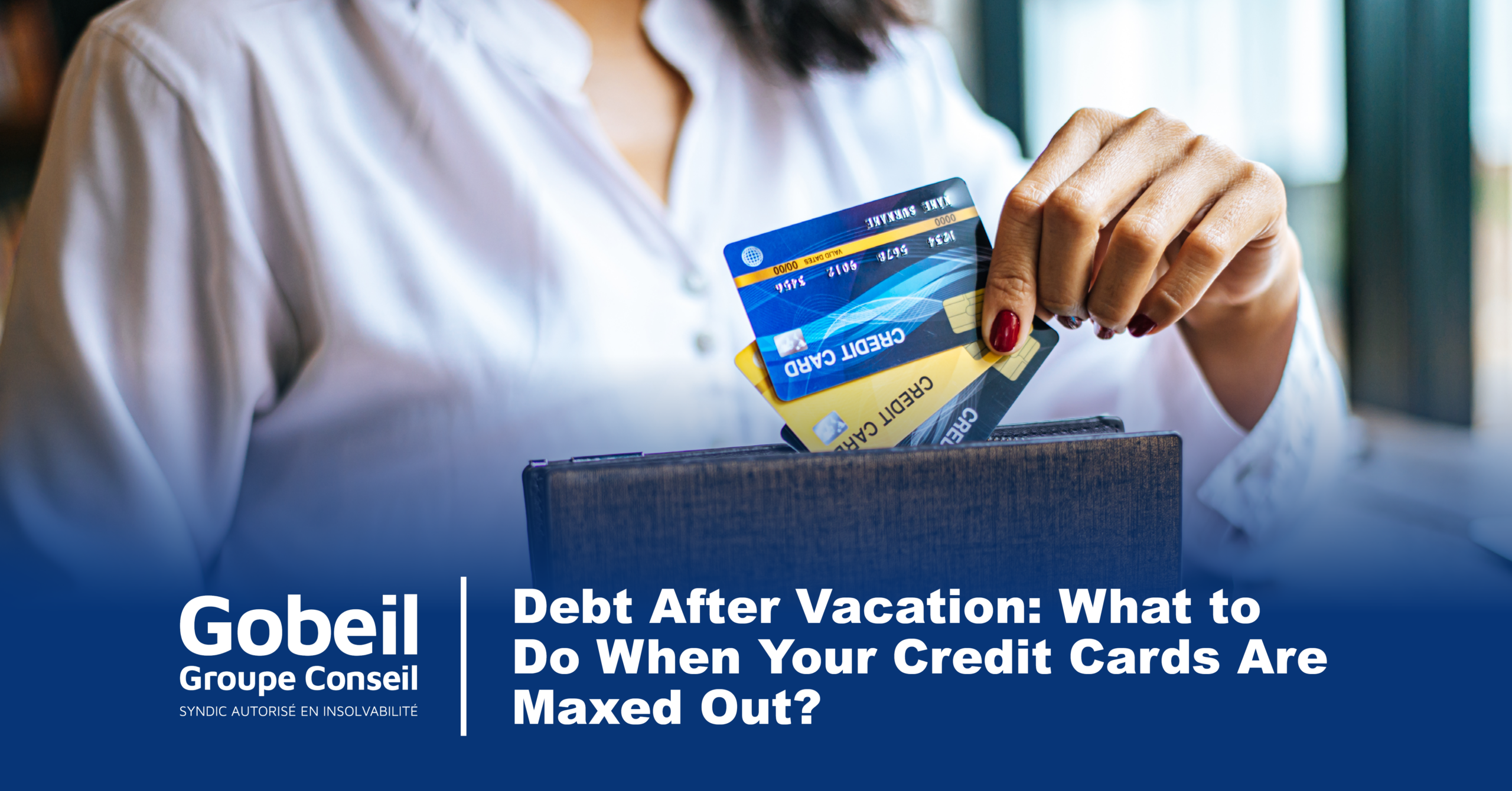
Debt After Vacation: What to Do If Your Credit Cards Are Maxed Out?
As everyday life resumes after summer vacation, many Quebecers discover that their finances have taken a hit. Credit card balances are higher than expected, and monthly payments become difficult to make.
This situation is even more concerning when vacations were financed with credit cards, lines of credit, or personal loans that were already heavily used before the trip.
Interest keeps piling up, minimum payments never seem to bring the balances down, and the return to regular expenses (rent, mortgage, groceries, back-to-school costs, and everyday bills) adds even more financial pressure.
The good news is that solutions exist.
And the sooner you act, the more options you have to take back control of your finances and prevent your debt from getting worse.
Why can vacation debt become hard to manage?
Vacation debt becomes a problem when credit card balances grow faster than your ability to pay them off, especially because of high interest rates.
Summer spending adds up quickly. Between gas, accommodations, restaurants, activities, and unexpected costs, it’s easy to go over budget.
For many people, these expenses are only part of the problem. Vacation costs sometimes pile onto an already difficult financial situation, where credit cards have been covering essential expenses for months. Back-to-school costs then add even more to the new credit card balances.
Making minimum payments often gives the impression that things are under control, but in reality, a large portion of that payment goes toward interest. And the higher the balance stays, the harder it becomes to regain financial balance.
How does credit card interest increase your debt?
Compound interest can really slow down credit card repayment. If you don’t pay the full balance every month, interest builds up on the remaining amount owed.
For example, someone with a total balance of $5,000 at a 20% annual interest rate can end up paying hundreds of dollars in interest alone over time if they only make minimum payments.
The problem is that the minimum payment covers part of the interest and only a small portion of the principal. As a result, the balance goes down very slowly.
Here are some examples:
| Situation | Starting Balance | Monthly Payment | Effect on Debt |
|---|---|---|---|
| Card used occasionally, balance paid off quickly | $5,000 | Full balance paid off each month | Little to no interest |
| Monthly payment higher than the minimum required | $5,000 | Higher amount each month | Gradual reduction of principal |
| Minimum payment only, for several months or years | $5,000 | Small monthly payment | Very long repayment period and significant interest |
| Very frequent use of the credit card | $5,000 and up | Variable monthly payments | The balance may keep growing |
High interest rates explain why many people feel like they’re making payments every month without managing to reduce their debt.
When credit cards start being used to cover essential expenses, it’s time to have your financial situation assessed without delay.
If this situation sounds like you, it may help to understand how to avoid the credit card debt spiral.

What are the signs that your credit cards have become a problem?
A credit card becomes a problem when you can no longer reduce its balance even though you’re making monthly payments. This indicates that your debt is starting to outpace your ability to repay it.
Here are some signs to watch for:
- You only make the minimum payment each month
- Your credit limit is nearly maxed out
- You use one credit card to pay off another
- You delay paying certain bills so you can make a payment on your card
- You avoid checking your statements out of fear of the amount owed
- You keep adding new charges to your cards
- You’re starting to receive calls or notices from creditors
- It’s becoming difficult to cover your everyday expenses without borrowing
When several of these situations happen at the same time, it’s best to seek professional help rather than wait for interest and late payments to keep piling up.
If your credit card debt is becoming difficult to pay off, there are solutions suited to every situation.
What should you do if your credit card is maxed out?
When your credit limit is reached, the priority is to get a clear picture of your situation before interest and late payments grow further out of hand.
Get a complete picture of your debts
Start by making a list of all your debts. Be sure to include:
- Credit cards
- Lines of credit
- Personal loans
- Tax debts
- Late payments
- Amounts in collections
Having a full picture will allow you to properly assess your situation and find the right solution.
Stop using credit for everyday expenses
Continuing to use your credit cards to pay for daily expenses can quickly make your debt worse.
Even though this may help temporarily, it increases balances and interest, which makes repayment more complicated. This can be a sign that your current income is no longer enough to support your level of debt.
Assess your real repayment capacity
It’s important to analyze your income, your fixed expenses, and the amount that’s actually available each month to pay down your debts.
If your minimum payments are eating up a large share of your budget without bringing the balances down, it’s more than time to look into solutions that could help.
The goal isn’t just to manage next month’s payments, but to regain a more manageable financial situation for the long term.
Compare the different solutions
Depending on your situation, several solutions may be worth considering.
Some people may qualify for debt consolidation, while others could benefit from a consumer proposal or, in certain cases, personal bankruptcy.
Each solution comes with its own advantages, limitations, and conditions. A thorough analysis helps determine which one truly fits your financial situation.
Comparing the main solutions when debt becomes hard to manage
The best solution depends on your income, your level of debt, and your real repayment capacity.
| Solution | How It Works | Possible Advantages | Points to Consider |
|---|---|---|---|
| Debt consolidation | Combine several debts into a single loan with one monthly payment | Simplified management, possibly a lower interest rate | Usually requires good credit and sufficient borrowing capacity |
| Consumer proposal | Make a repayment offer to creditors through a Licensed Insolvency Trustee | Allows (in most cases) repayment of only a portion of debts and stops interest on certain debts. The minimum payment is reduced based on your ability to pay | Must be accepted by creditors under the rules set out by law |
| Personal bankruptcy | A legal process for settling certain debts under the Bankruptcy and Insolvency Act | Can offer a solution when debt has become impossible to manage | Financial consequences to review with a professional |
| Personal repayment plan | Reorganize your budget and gradually pay down your debts | Lets you keep control without a formal process | Can be difficult when minimum payments exceed your financial capacity |
Before choosing a solution, you’ll need to have your financial situation analyzed. Two people with the same amount of debt can have access to completely different solutions depending on their income, expenses, and goals.
A Licensed Insolvency Trustee can help you understand your options and determine which path best fits your reality.
Can debt consolidation help after vacation?
Debt consolidation can help some people combine their debts into a single monthly payment (on a single loan). Here are the advantages:
- A single monthly payment
- An interest rate that’s sometimes lower than credit cards
- Simplified financial management
This debt solution isn’t available to everyone. Financial institutions assess income, financial stability, and credit history before approving a consolidation loan.
Once the debt is repaid, it’s important not to go back to using credit cards the same way, as this can quickly lead to a high level of debt again.
When should you consider a consumer proposal?
When minimum payments are no longer enough to regain control of your finances and interest keeps growing, a consumer proposal is a very advantageous solution to consider.
It’s a process governed by the Bankruptcy and Insolvency Act, administered by a Licensed Insolvency Trustee. It involves presenting a repayment offer to your creditors that’s tailored to your financial capacity.
Depending on your file, a consumer proposal can allow you to:
- Combine your unsecured debts into a single, reduced monthly payment
- Stop paying interest on your eligible debts
- Repay only a portion of your debts
But every situation is different. The amount you could repay depends on your income, your expenses, the value of your assets, and your total debt. That’s why a personalized analysis by a trustee is always necessary.
Check out this article if you’d like to better understand how a consumer proposal works.
Is bankruptcy the only option if your cards are maxed out?
No. Having maxed-out credit cards doesn’t automatically mean you have to file for bankruptcy.
Many people immediately associate high debt with personal bankruptcy. Yet several solutions can be considered before reaching that point.
Personal bankruptcy is a legal measure that may only be suitable in certain situations. Depending on your income, your level of debt, and your repayment capacity, a consumer proposal or debt consolidation could be more appropriate.
The trustee’s role is to assess your entire situation, then explain the different solutions along with their consequences and advantages.

Why consult before the situation gets worse?
The sooner you consult a trustee (this can be done by phone, video conference, or email), the more choices you’ll have among the solutions that can help you regain control of your finances.
Waiting several months can lead to various consequences:
- A significant buildup of interest
- Late payments that keep piling up
- Calls or collection efforts
- Notices of legal proceedings
- Wage garnishment in some situations
- A deterioration of your credit file
Many people only reach out when they feel like they have no way out. Yet a simple call and a few emails are often enough to assess what solutions are available, before financial difficulties become too great.
A phone consultation with a Licensed Insolvency Trustee will give you explanations tailored to your financial reality, with no obligation on your part.
Returning from vacation can be the right time to take back control
Returning from vacation can sometimes reveal a more difficult financial situation than expected. Credit card balances rise, minimum payments pile up, and interest makes repayment increasingly complicated.
What matters is not waiting until debts become impossible to manage. The sooner you act, the more opportunities you’ll have to explore solutions tailored to your situation.
Whether you want to better understand your options, check whether debt consolidation is possible, or find out if a consumer proposal could suit your situation, our advisor will guide you through your reflection.
Frequently Asked Questions
What should I do if my credit card is maxed out? Start by getting a complete picture of your debts, stop using credit for everyday expenses, and assess your real repayment capacity (by putting together a detailed budget). If payments are becoming difficult to manage, it would be helpful to consult a trustee to learn about the solutions available to you.
Is it a problem to pay only the minimum on my credit card? Paying only the monthly minimum generally keeps you from defaulting, but this strategy often reduces the balance very little since interest keeps building up. Over the long term, the total cost of the debt can increase significantly.
Can I consolidate my debts after vacation? Yes, some people can get a consolidation loan to combine their debts into a single monthly payment. However, this solution depends on your credit history, your income, and your borrowing capacity.
Can a consumer proposal include credit card debt? Yes. Credit card debt is generally considered unsecured debt, which can be included in a consumer proposal. That said, eligibility and terms are assessed on a case-by-case basis.
Do I have to file for bankruptcy if I can no longer pay my credit cards? No. Personal bankruptcy isn’t automatically the best solution. Other options, such as debt consolidation or a consumer proposal, may sometimes be more appropriate depending on your financial situation.
When should I consult a Licensed Insolvency Trustee? It’s recommended to consult as soon as payments become difficult to make, interest starts increasing quickly, or you’re using credit to cover everyday expenses. The earlier you consult, the more solutions you’ll be able to explore.
Take back control of your finances with Gobeil Syndic
If your credit cards are maxed out after vacation, you don’t have to wait until the situation becomes unmanageable.
A free phone consultation with our advisor at Gobeil Syndic will let you review your situation, your debts, your income, and the solutions that could work for you.
The goal is to help you make an informed decision and regain lasting financial stability.
We serve every city in Quebec, since everything can be done remotely.